
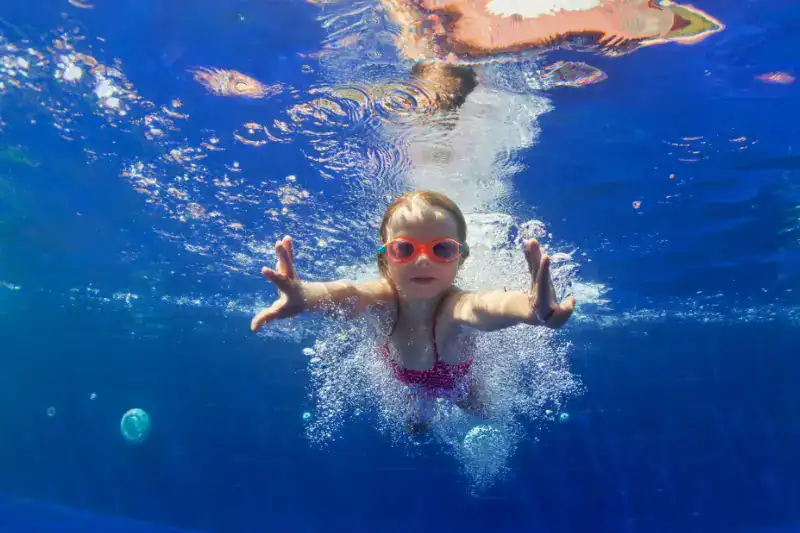
Learning to swim is a critical life skill that creates a foundation for safety, health, and personal growth.
Formal classes provide structured benefits that reach beyond the pool.
Let’s look at the top advantages of enrolling your child in swim lessons.
1. Drowning Prevention & Water Safety
Formal instruction helps reduce drowning risk, a leading cause of accidental death for young children.
- Studies have shown that formal swim lessons can reduce the risk of drowning by as much as 88% for children aged 1-4.
- Children practice fundamental safety skills, such as entering and exiting the water safely, responding if they fall in unexpectedly, floating on their back, and reaching the side of the pool.
- Instructors guide children to respect the water. Children realize that while swimming is fun, they must also understand potential dangers and follow safety rules.
2. Improved Physical Health
Swimming provides a comprehensive, full-body workout and offers low-impact exercise, keeping children’s joints and bones protected.
- As they swim, children strengthen their hearts and lungs, which boosts cardiovascular endurance. The constant use of large muscle groups keeps the heart rate elevated in a healthy, sustained way.
- Because pushing and pulling through water offers resistance, children build lean muscle and enhance strength in their arms, legs, and core.
- Swimming requires bilateral, cross-body movements—using opposite arms and legs together—which improves coordination and balance. Children transfer these skills to other sports and daily activities.
3. Development of Social Skills
Group swim lessons immerse children in an environment where they interact with peers and instructors, developing crucial social skills.
- While in the pool, children take turns, share equipment, and offer encouragement to peers. These interactions promote teamwork and cooperation.
- For shy children, practicing social interaction in a small group activity like swim lessons can offer a safe space.
- By following an instructor’s directions, children learn to listen, pay attention, and respect authority figures.
4. Boosted Confidence and Self-Esteem
The process of learning to swim involves overcoming fears and achieving tangible goals, which has a positive impact on self-esteem.
- With a patient instructor, many children overcome fear of the water step by step and prove to themselves they can conquer challenges.
- With each milestone achieved — from blowing bubbles to floating and then swimming unassisted — children experience a sense of accomplishment as they progress through the lesson levels.
- As children master swimming, they gain independence and self-reliance in the water.
5. Enhanced Cognitive Function
Swimming stimulates brain development and boosts cognitive function. The complex movements and sensory experiences engage the brain powerfully.
- Cross-patterning movements during swimming build neural pathways in the brain. These new connections improve reading skills, language development, and academic learning.
- Learning and perfecting different strokes demands focus and concentration, which can translate to improved attention span in other areas, such as the classroom.
- Moving through the water to achieve a goal involves physical problem-solving.
6. A Lifelong Skill for Recreation & Fitness
Unlike some sports, swimming gives children a skill for life. Teaching kids to swim gives them lifelong opportunities for fitness.
- Once children become competent swimmers, a spectrum of activities, such as kayaking, surfing, water skiing, and snorkeling, becomes accessible to them.
- Swimming is an excellent, low-impact form of exercise for people of all ages, including seniors. This activity helps you stay active and healthy throughout life.
- Children and adults participate fully and safely in pool parties, beach trips, and lake vacations by knowing how to swim.
7. Improved Sleep Patterns
Swimming, in particular, can be especially effective at improving sleep quality, due to its physical benefits.
- A 30- or 60-minute swim lesson is a great way for a child to burn off excess energy in a constructive way.
- While swimming is a workout, the sensation of being in the water can also be very calming and relaxing.
- Physical exertion and mental stimulation help you achieve deeper, more restful sleep.
8. Better Management of Asthma
For children with asthma, swimming is one of the best forms of exercise. The warm, moist air in an indoor pool environment can make breathing easier.
- Humidity around the swimming pool soothes asthma-induced airway inflammation.
- Swimming increases lung capacity and teaches breath control, helping children manage asthma symptoms.
- Consult a Doctor First: It’s always essential for parents of children with asthma to consult their pediatrician before starting any new exercise program, including swimming.
9. Discipline & Resilience
Learning to swim takes time, practice, and perseverance.
- To become a skilled swimmer, children need to attend lessons regularly and practice consistently. By doing so, they develop discipline and a strong sense of commitment.
- A child may have difficulty mastering a particular skill, such as floating or treading water, but with an instructor’s guidance, persistence helps them persevere and develop resilience.
- Children build mental toughness by pushing through difficult sets or trying new, challenging skills.
10. Fun & Enjoyment
Children enjoy swimming. Swim lessons provide an enjoyable and positive experience.
- Lessons combine learning with games and activities, making the process enjoyable.
- A good swim program encourages children to build a positive and joyful relationship with water from a young age.
- Kids have fun, make friends, and stay active in a healthy, productive way.
FAQs About Swimming Benefits
What’s the best age to start swim lessons?
Most experts agree that children can start formal swim lessons around age 1, but parent-and-child water acclimation classes can begin even earlier. The American Academy of Pediatrics supports lessons for most children aged 1 and older.
How long does it take a child to learn to swim?
This varies greatly from child to child. Factors include age, developmental readiness, prior experience with water, and lesson frequency. Instead of focusing on a timeline, it’s better to view swimming as a continuous journey of skill development.
What should my child wear to swim lessons?
A comfortable, well-fitting swimsuit. For children who are not yet potty-trained, most pools require a reusable or disposable swim diaper. Goggles are highly recommended to protect their eyes from chlorine and help them see clearly underwater. A swim cap can be useful for children with long hair.
Are private lessons better than group lessons?
Neither is inherently “better”; they just serve different purposes. Group lessons are great for socialization, learning in a peer environment, and are more cost-effective. Private lessons offer one-on-one attention, which can be beneficial for very fearful children or those with specific needs who need to progress at their own pace.
How can I help my child practice between lessons?
You can practice skills during family pool time or even in the bathtub. For young children, practice blowing bubbles, pouring water over their head, and getting their face wet. For older kids, you can review floating on their back and kicking with a kickboard, as long as you closely supervise.
What if my child is afraid of the water?
Fear of the water is common. A good swim program will have experienced instructors who know how to work with anxious children. The key is patience and a gentle, gradual approach. Never force a fearful child. Instead, allow them to progress at their own pace with plenty of encouragement.
Are floaties and water wings safe for learning to swim?
While popular, most swim safety experts advise against using floaties, water wings, or other inflatable flotation devices. They can provide a false sense of security and teach children an incorrect, vertical posture in the water. A U.S. Coast Guard-approved life jacket is the recommended device for non-swimmers when near open water, but it should not be used as a teaching tool during lessons.
What qualities should I look for in a swim school or instructor?
Look for certified instructors with experience teaching children in your child’s age group. The program should have a low student-to-instructor ratio and a clear, progressive curriculum. Observe the class, if possible, to see if the instructors are patient, engaging, and prioritize safety. The facility should be clean and well-maintained.
Leave A Comment