

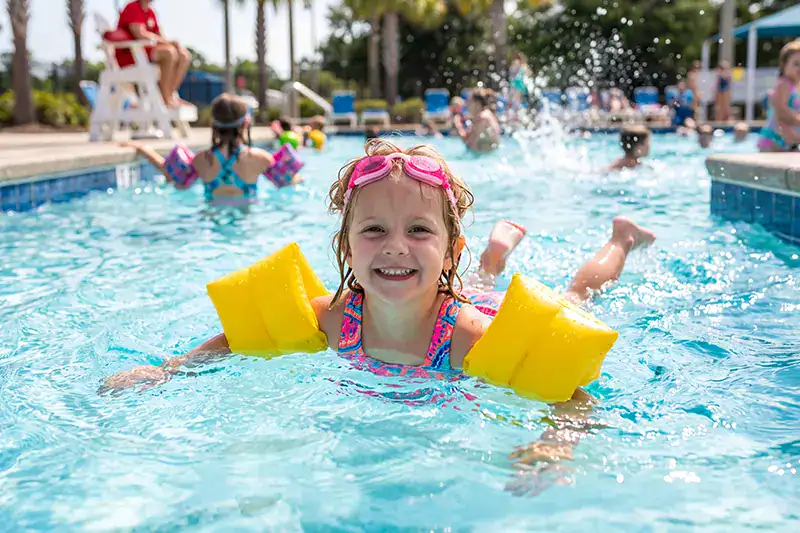
Every summer, parents strap floaties onto their kids’ arms and feel a sense of security. The kids look buoyant; they’re splashing happily, and it feels like a problem has been solved.
But floaties — those colorful inflatable armbands — aren’t safety devices. They’re swim aids. And confusing the two can have serious consequences.
This post explains why floaties can actually increase risk, what safer alternatives exist, and what every parent and caregiver should know before the next pool day.
What Are Floaties & Why Aren’t They Safety Devices?
Floaties, also called water wings or arm bands, are inflatable toys designed to help young children stay afloat while learning to swim. They’re inexpensive, widely available, and beloved by toddlers everywhere.
But they are NOT certified personal flotation devices (PFDs).
-
- Floaties aren’t approved by the U.S. Coast Guard
They aren’t designed to keep an unconscious child’s airway above water
They can deflate suddenly
They can slip off small arms, especially when wet
They position children vertically in the water, which isn’t a safe drowning-rescue position
The US Consumer Product Safety Commission warns that inflatable swimming aids are not life preservers and should never be used as a substitute for adult supervision.
How Floaties Create a False Sense of Security
The real danger isn’t the floaties themselves; it’s the behavioral shift they cause in adults.
When a child is wearing floaties, parents and caregivers often:
-
- Step further away from the pool or water’s edge
Check their phones more frequently, assuming the child is safe
Reduce physical supervision, believing the device is doing the work
Allow children to go into deeper water than they would otherwise
This is what safety experts call “risk compensation” — when a perceived safety measure causes people to take greater risks than they otherwise would.
A child in floaties can still drown. Drowning is often silent. There’s no dramatic splashing or screaming. It can happen in seconds, even when a child appears to be floating comfortably.
What the Research Says About Child Drowning Risk
Drowning is one of the leading causes of accidental death in children ages 1–4 in the United States, according to the Centers for Disease Control and Prevention (CDC). Key statistics:
-
- Drowning is the #1 cause of accidental injury death for children ages 1–4
Most drownings occur in residential swimming pools
A child can drown in the time it takes to answer a text message
Children can drown in as little as 2 inches of water
No flotation device replaces watchful adult supervision.
Safer Alternatives to Floaties
If floaties aren’t safe for solo use, what should parents use instead? There are better options depending on the situation.
Coast Guard-Approved Life Jackets
For open water — lakes, rivers, boats, and beaches — always use a properly fitted, US Coast Guard-approved life jacket. Look for:
-
- The correct weight range printed on the label
A snug fit (you should not be able to pull it over the child’s chin)
A grab handle on the back for quick rescue
Swim Vests & Learn-to-Swim Aids
For pool settings and structured swim lessons, swim vests are designed to provide buoyancy while allowing more natural body movement. These are better for building swimming skills than armbands.
Swim Lessons
The most effective long-term safety tool is swim instruction. Formal swimming lessons can reduce the risk of childhood drowning by up to 88%.
-
- Start lessons as early as age 1, per American Academy of Pediatrics guidelines
Look for programs that teach water survival skills, not just strokes
Practice water safety rules alongside swimming skills
What Parents Should Do at the Pool
Floaties or not, the following rules are non-negotiable:
Designate a Water Watcher
-
- : One adult whose only job is to watch the water — no phones, no conversations, no distractions
Maintain arm’s reach: For non-swimmers and young children, stay within arm’s reach at all times
Learn CPR: The Red Cross offers free and low-cost CPR certification courses
Fence the pool: Four-sided pool fencing with a self-latching gate reduces drowning risk by up to 83%
Establish rules: No running, no pushing, no swimming without an adult present
Are Floaties Ever Okay to Use?
Floaties still serve a purpose when handled properly.
-
- Treat them as swim training aids, not safety devices
Never leave a child unattended while wearing floaties
Always combine floaties with direct adult supervision
Check for deflation before each use
Don’t use floaties in open water or deep pools
Think of floaties as training wheels. They support learning, but a parent still stands nearby when a child first rides a bike.
The Bottom Line on Floaties & Water Safety
Floaties have their place, but not as a substitute for supervision or a certified life jacket. The false confidence they can create in adults is what makes them risky.
The safest thing you can do for a child near water is stay close, stay focused, and invest in real swim education. Enroll kids in lessons early, learn CPR, and use Coast Guard-approved devices for open water.
Water safety starts long before a child ever gets in the pool.
FAQs: Floaties & Water Safety
Q: Are floaties safe for toddlers?
Floaties can be used as swim training aids for toddlers, but they are not safety devices. They are not Coast Guard-approved and can deflate or slip off. Always supervise toddlers within arm’s reach, regardless of whether they are wearing floaties.
Q: What is the difference between floaties and a life jacket?
Life jackets are US Coast Guard-approved personal flotation devices designed to keep a child’s head above water, even if the child is unconscious. Floaties are inflatable toys used as swim aids. They don’t meet federal safety standards and should not be used in open water or as a substitute for a life jacket.
Q: At what age should kids stop using floaties?
There is no set age, but children should transition out of floaties as they develop real swimming skills. Swim lessons are the most effective way to build water confidence and safety. Most experts recommend starting swim lessons around age 1.
Q: Can a child drown while wearing floaties?
Yes. Floaties can deflate, slip off, or fail to keep a child in a safe position in the water. Drowning can occur quickly and silently, even when a child appears to be floating safely. Adult supervision is always required.
Q: What should I use instead of floaties for pool safety?
For open water and boating, use a properly fitted, Coast Guard-approved life jacket. For pool settings, consider swim vests designed for learn-to-swim programs. Long-term formal swim lessons are the most effective water-safety investment.
Q: How close should I stay to my child in the pool?
For non-swimmers and young children, stay within arm’s reach at all times. Designate one adult as a Water Watcher — a role focused solely on monitoring the water without distractions such as phones or conversations.
Q: Do floaties help kids learn to swim?
Floaties can provide buoyancy that helps children feel comfortable in the water, but they may also delay the development of proper swimming technique by encouraging an upright body position. Swim vests or structured swim lessons are generally better tools for developing real swimming skills.
Q: How can I reduce drowning risk at home if I have a pool?
Install four-sided pool fencing with a self-latching gate, which the CDC says can reduce drowning risk by up to 83%. Establish clear water rules for children, learn CPR, and always designate a Water Watcher during pool time.
Leave A Comment