

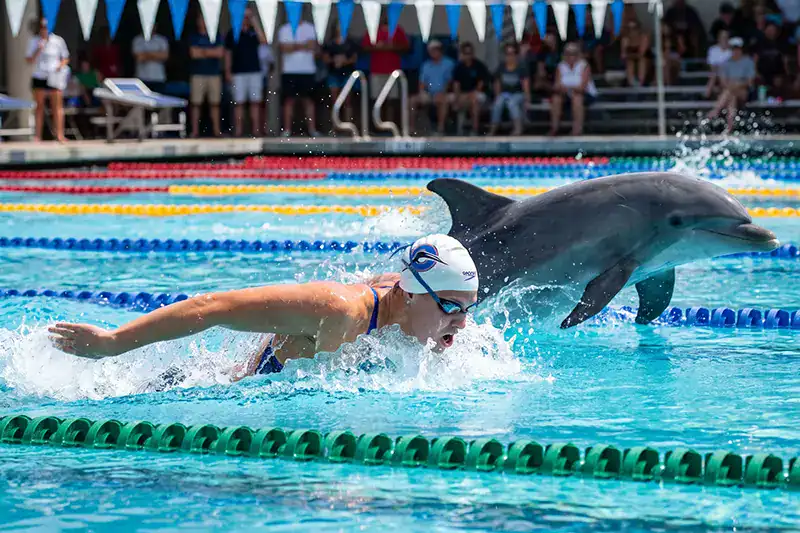
Water is 800 times denser than air — meaning every lap is a war against physics.
Most swimmers try to overpower the pool with raw muscle, only to end up exhausted, frustrated, and stuck at the same split times. But elite athletes know the secret: you don’t beat the water with force; you beat it with fluid dynamics.
Here is how to turn cold, hard science into explosive speed.
1. Streamline Your Body Position
Drag is the resistance that slows you down with every stroke. It comes in three forms: form drag, wave drag, and friction drag.
Form drag is the biggest problem. The more surface area your body presents to the water, the more resistance you create. A horizontal, flat body position cuts through the water far more efficiently than one in which the hips or legs sink.
Tips:
- Keep your head neutral — looking straight down, not forward
- Engage your core to keep your hips high
- Push off walls in a tight, streamlined position to maximize momentum
2. Use Buoyancy to Your Advantage
Buoyancy is the upward force water exerts on your body. Everyone’s buoyancy is slightly different depending on body composition — fat tissue floats more easily than muscle.
The goal is to work with your buoyancy. Swimmers who kick too hard, trying to stay afloat, waste energy that could propel them forward. A relaxed, efficient kick keeps you horizontal without burning out your legs.
Tip: Practice floating face-down in a relaxed position. Notice your natural body position in the water — that’s your baseline to build from.
3. Generate Propulsion Through an Efficient Stroke
Newton’s Third Law: for every action, there’s an equal and opposite reaction. When your hand pushes water backward, your body moves forward. The key is making that push as effective as possible.
A high elbow catch — where your elbow stays high, and your forearm faces backward early in the stroke — maximizes the surface area pushing against the water. A dropped elbow wastes that propulsive force immediately.
Tips:
- Focus on the early catch phase of each stroke
- Pull water straight back, not outward or inward
- Keep your fingers slightly spread — research suggests this can increase propulsive force by up to 10%
4. Minimize Wave Drag with Smoother Technique
Every time you move through water, you create waves. Those waves create resistance. The faster you swim, the more wave drag increases — which is why elite swimmers invest so heavily in technique at high speeds.
Minimizing unnecessary head and body movement is key. Side-to-side fishtailing, excessive head lifting to breathe, and wide arm recovery all generate turbulence that slows you down.
Tips:
- Rotate your body along its long axis to breathe, rather than lifting your head
- Keep your arm recovery close to your body
- Train at race pace regularly so your technique holds up under effort
5. Optimize Your Kick for Propulsion, Not Just Balance
The kick serves two purposes: propulsion and balance. In freestyle and backstroke, the kick primarily stabilizes the body and maintains rotation rhythm. In butterfly and breaststroke, it’s a major propulsive force.
An efficient freestyle kick originates from the hip, not the knee. A knee-driven kick creates drag and burns your legs fast. Aim for a compact kick with relaxed ankles — stiff feet act like brakes.
Tip: Kick sets with a kickboard are good for conditioning, but vertical kicking drills (treading water using only your legs) better replicate the body position used in freestyle.
6. Use Turns & Walls to Maintain Momentum
A strong flip turn and push-off can save significant time over a full swim set. Underwater, you move faster than on the surface — there’s no wave drag below. Elite swimmers exploit this with extended dolphin kicks off every wall.
The push-off streamline is one of the fastest moments in any swim. Blowing that momentum with a rushed breakout is a common mistake.
Tips:
- Stay in streamline for at least 3–5 meters off every wall
- Add 2–3 dolphin kicks underwater before your first stroke
- Practice your flip turn approach so you don’t have to adjust your stride coming in
7. Improve Your Lung Efficiency & Breathing Pattern
Breathing disrupts your stroke rhythm and body position. Every time you breathe, you rotate your head and disrupt your streamline, which increases drag.
That doesn’t mean breathing less. It means breathing smarter. Bilateral breathing (alternating sides) balances your stroke and prevents muscle imbalances over time. Breathing every two to three strokes, rather than every stroke, keeps your stroke more symmetrical and efficient.
Tips:
- Practice exhaling continuously underwater so your breath is quick and sharp when you turn to breathe
- Work on hypoxic sets in training to improve CO₂ tolerance
- Experiment with breathing patterns to find what works best at race pace
FAQs: How to Swim Faster
Q: How does drag affect swimming speed?
Drag is the resistance force water exerts on your body as you move through it. The greater your drag, the more energy you need to maintain speed. Reducing drag — through better body position, streamlined technique, and smoother movement — is one of the most effective ways to swim faster without increasing effort.
Q: What is the most important physics concept for swimmers?
Drag reduction has the biggest practical impact. However, propulsion efficiency — how effectively each stroke moves you forward — is also important. The two work together: less drag means each stroke carries you further.
Q: Does body composition affect swimming speed?
Yes. Muscle is denser than water and tends to sink, while body fat is less dense and floats. Swimmers with higher body fat often have a natural buoyancy advantage. That said, technique and fitness outweigh body composition for most recreational swimmers.
Q: Is a two-beat or six-beat kick faster?
It depends on the swimmer and the event. A six-beat kick (six kicks per arm cycle) generates more propulsion and is common in sprint events. A two-beat kick is more energy-efficient and is used by many distance swimmers. Most competitive swimmers adapt their kick tempo to the race distance.
Q: Why do competitive swimmers wear tech suits?
Tech suits are made from materials that compress the body, reduce friction drag, and repel water. Studies have shown they can reduce drag by up to 10%, resulting in meaningful time savings. They’re designed to work in tandem with good technique. They won’t compensate for a poor stroke.
Q: How do dolphin kicks help swimmers go faster?
Underwater dolphin kicks generate propulsion while avoiding wave drag, which only occurs at the surface. Swimmers move faster underwater than on the surface, which is why elite swimmers maximize their underwater distance off starts and turns.
Q: Does pool water temperature affect swimming speed?
Yes. Warmer water is slightly less dense and viscous than cold water, which can marginally reduce drag. FINA (World Aquatics) mandates competition pools be kept between 25–28°C (77–82°F) for this reason, among others related to athlete safety and comfort.
Q: How often should swimmers focus on technique vs. conditioning?
Both matter, but technique should never take a back seat, especially for developing swimmers. Poor mechanics practiced at high volume become ingrained habits that are difficult to undo. If your technique breaks down noticeably when you’re tired, you’ve likely crossed into pure conditioning territory. Build technique first, then layer in conditioning work.
Leave A Comment