
Swimming faster is about more than effort. It’s about improving efficiency.
Every swimmer is affected by two forces:
- Propulsion, which moves you forward.
- Drag, which slows you down.
The fastest swimmers maximize propulsion while minimizing resistance. Even small improvements in technique can significantly increase speed, reduce fatigue, and improve performance.
The Science of Speed: Propulsion vs. Drag
Swimming speed boils down to a simple equation: Speed = Propulsion – Drag.
To swim faster, you must either increase the force that moves you forward (propulsion) or decrease the forces that hold you back (drag). The best swimmers do both.
Understanding Drag
Drag is the resistance you feel as you move through the water. It’s the single biggest obstacle to speed. Three types of drag affect swimmers:
- Form Drag: This relates to your body’s shape and position in the water. A flat, streamlined body creates less resistance than an angled or bulky one. Think of how a sleek torpedo moves through water compared to a wide barge.
- Wave Drag: This is the resistance created by the waves you generate as you swim. The faster you move, the bigger the waves, and the more energy is required to overcome them.
- Frictional Drag: This is caused by the friction between your skin (and swimsuit) and the water. While it has less impact than form or wave drag, it’s why competitive swimmers wear specialized suits and caps.
Maximizing Propulsion
Propulsion is the force you generate to move yourself forward. In swimming, your hands, forearms, and feet act like paddles.
The goal is to catch as much water as possible and push it backward, which, according to Newton’s Third Law (for every action, there is an equal and opposite reaction), propels you forward.
Effective propulsion depends on your stroke mechanics, your kick, and your ability to engage your entire body in the movement.
Techniques to Reduce Drag
A streamlined, horizontal alignment reduces form drag and allows you to cut through the water with the least resistance.
Maintain a Horizontal Body Line
Your primary goal is to keep your body as flat and close to the surface as possible. When your hips or legs drop, you increase your frontal surface area, thereby increasing drag.
Head Position
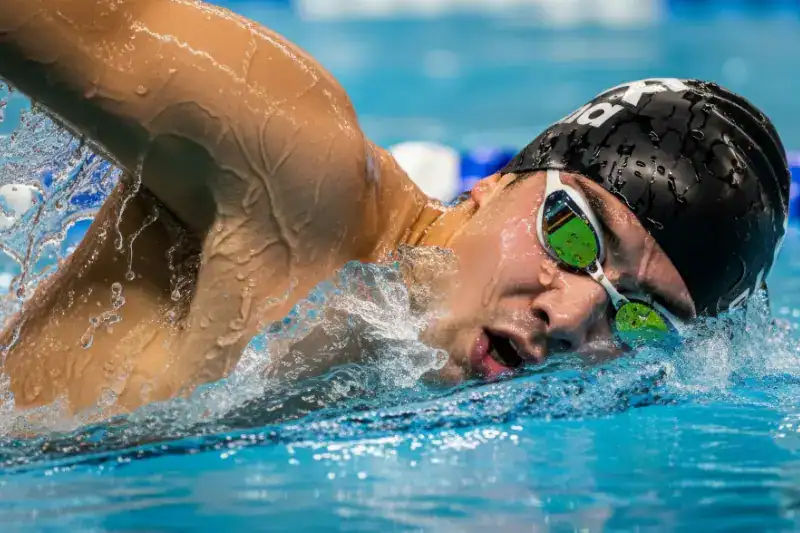
Keep your head in a neutral position, with your eyes looking down at the bottom of the pool, not forward. Imagine a line extending from the top of your head down your spine. For freestyle, as you rotate to breathe, keep your head in line with your body rather than lifting it.
Core Engagement
A strong core is essential for connecting your upper and lower body and preventing your hips from sagging. Actively engage your abdominal and lower back muscles to maintain a stable torso.
“Swim Downhill”
Many coaches use the cue “swim downhill.” This involves pressing your chest slightly into the water, which helps elevate your hips and legs, creating a more streamlined position.
Master the Streamline
The streamline is the most efficient swimming position and should be used off every wall and dive. It sets the tone for your entire lap.
- Lock your hands, one over the other.
- Squeeze your arms tight against your ears, covering them with your biceps.
- Engage your core and point your toes.
- Your body should be as tight and narrow as possible. Hold this position for several seconds after pushing off the wall before taking your first stroke.
Propulsive Power: Fine-Tuning Your Stroke
Once you have a solid body position, the next step is to optimize the force you generate with your arms and legs. This involves refining your “catch” and ensuring your entire body contributes to the stroke.
The High-Elbow Catch
The high-elbow catch (also known as Early Vertical Forearm or EVF) is the most critical component of an effective freestyle and backstroke pull. It allows you to use your entire forearm and hand as a paddle, rather than just your hand.
- After your hand enters the water, instead of pulling straight back with your elbow dropped, focus on keeping your elbow high and near the surface.
- Bend your wrist and elbow to point your fingertips toward the bottom of the pool as early as possible.
- This creates a large, firm “paddle” with your hand and forearm, allowing you to “catch” the water and pull your body past it. Avoid letting your elbow drop and lead the pull, which reduces your propulsive surface.
The Power of Body Rotation
Powerful swimming comes from your core, not just your arms and shoulders. Rotating your hips and torso with each stroke generates significant power and increases your reach.
- In freestyle and backstroke, focus on rotating from your hips, allowing your shoulders to follow.
- This rotation engages your larger core muscles, taking the strain off your smaller shoulder muscles.
- It also allows you to extend your reach at the front of the stroke and achieve a more powerful finish at the back. Imagine your body is a log rolling from side to side.
Developing a Strong, Effective Kick
While the pull provides most of the propulsion in freestyle, a strong kick is vital for stability, rotation, and supplemental speed.
- Kick from the Hips: Your kick should originate from your hips, not your knees. The motion should be a fluid whip, with a slight bend in the knee and a relaxed ankle.
- Small, Fast Kicks: For distance and efficiency, focus on a small, fast flutter kick that stays within the “shadow” of your body. Large, splashy kicks often create more drag than propulsion.
- Purpose of the Kick: The primary role of the kick in freestyle is to provide lift for the legs and drive body rotation, keeping you streamlined.
Training Strategies for Speed
Improving your technique is only half the battle. Your training plan must be structured to build speed and endurance.
Incorporate Drills
Drills are exercises that isolate specific parts of your stroke, helping you correct flaws and build muscle memory for proper technique.
- Fingertip Drag Drill: For freestyle, drag your fingertips along the surface of the water during the recovery phase. This encourages a high-elbow recovery.
- Single-Arm Drill: Swim using only one arm while the other remains extended in front. This helps you focus on your catch, pull, and rotation on each side.
- Kickboard Drills: Use a kickboard to isolate your legs and build kicking strength and endurance.
Use Training Equipment Wisely
Fins, paddles, and buoys can be valuable tools when used correctly.
- Fins: Help you feel the sensation of moving faster through the water, and can improve ankle flexibility.
- Paddles: Increase the surface area of your hands, helping you build strength and focus on a high-elbow catch. Use paddles that are only slightly larger than your hands to avoid shoulder injury.
- Pull Buoy: Placed between your legs, a pull buoy isolates your upper body, allowing you to focus entirely on your pull mechanics without kicking.
Integrate Sprint and HIIT Sets
To swim fast, you have to practice swimming fast. Incorporate sets of short, high-intensity sprints into your workouts.
- Example Set: 8 x 50 meters fast on a 1:30 interval. Give yourself enough rest to maintain maximum effort in each sprint.
- This type of training builds anaerobic capacity, which is crucial for racing and improving your top-end speed.
FAQs: How to Swim Faster
How often should I swim to get faster?
For noticeable improvement, aim to swim at least 3-4 times per week. Consistency is more important than the duration of any single session. This frequency allows your body to adapt to the training and helps build muscle memory for new techniques.
Why do my legs sink when I swim?
Sinking legs are usually caused by lifting your head too high to look forward or breathe. This causes your hips and legs to drop as a counterbalance. Focus on keeping your head in a neutral position, looking down, and engaging your core to help keep your body level.
Is dry-land training necessary for swimming faster?
Yes, dry-land training is highly beneficial. Strength training, particularly focused on the core, back, and shoulders, provides the power behind your stroke. Exercises like pull-ups, planks, and medicine ball throws can directly translate to more force in the water. Flexibility work, such as yoga, is also important for improving the range of motion.
What is the best way to breathe in freestyle?
The key is to breathe to the side with minimal disruption to your body line. As your arm recovers over the water, rotate your head with your body, keeping one goggle in the water. It should feel like your head is a natural extension of your spine. Avoid lifting your head up to breathe, as this creates significant drag.
How long does it take to see results in my swim time?
Results vary, but with focused, consistent practice on technique, many swimmers see improvements in their times within 4-6 weeks. Major breakthroughs may take several months as your body builds new muscle memory and strength. Should I use a snorkel for training?
A center-mount snorkel can be an excellent training tool. It allows you to focus completely on your body position and stroke mechanics without having to turn your head to breathe. This can help you refine your pull, rotation, and balance in the water.
How do I know if my technique is correct?
Self-awareness is a start, but objective feedback is best. Ask a coach or experienced swimmer to watch you, or better yet, record yourself swimming. Video analysis is one of the most effective ways to see what you are actually doing in the water versus what you think you are doing.
Does my swimsuit really affect my speed?
For recreational and fitness swimming, a comfortable suit is most important. For competitive swimmers, however, a technical racing suit can make a difference. These suits are designed with hydrophobic materials and compression to reduce frictional drag and improve muscle efficiency, potentially shaving seconds off your time.
Leave A Comment