
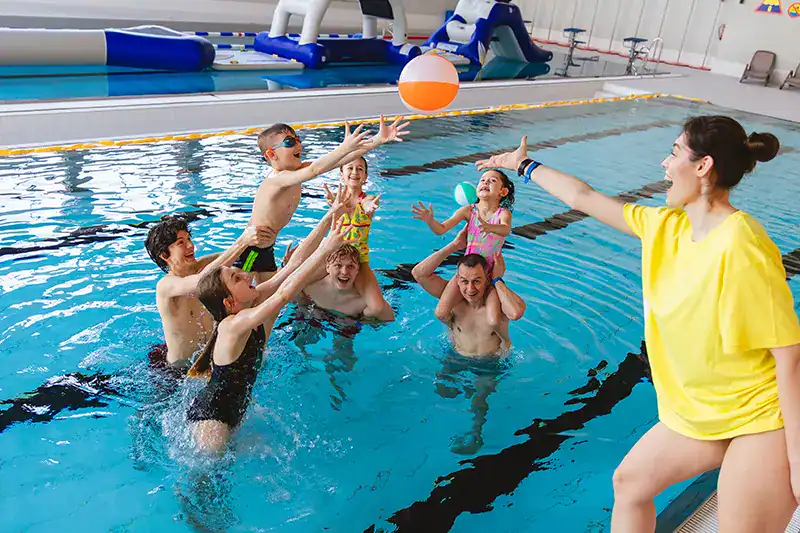
Water safety is non-negotiable, but forcing a toddler through structured, drill-heavy swim lessons usually backfires. Children under six aren’t wired for passive instruction or repetitive drills. They absorb the world through sensory play, movement, and curiosity.
Play-based swim instruction works because it aligns with natural child development:
- Zero force, lower fear: Imaginative play reduces anxiety, so kids engage willingly.
- Faster skill adoption: Fun games encourage endless repetition without burnout.
- Lasting confidence: Positive associations with the water build real safety skills naturally.
Here’s why play-based swim instruction delivers stronger results, what a great lesson looks like in action, and how to choose the right program for your family.
What Is Play-Based Swim Instruction?
Play-based swim instruction uses games, songs, imaginative scenarios, and child-led exploration to teach water safety and swimming skills. Instead of focusing on technique first, it prioritizes comfort, confidence, and positive association with water.
Key elements include:
- Games and songs that build skills without children realizing they’re “practicing”
- Repetition through play, so movements become natural rather than forced
- Child-led pacing, allowing kids to build confidence before progressing
- Positive reinforcement over correction-heavy feedback
This is fundamentally different from traditional instruction, which often emphasizes stroke mechanics and structured drills — approaches better suited to older, more developmentally ready learners.
Why Does Play-Based Learning Work for Young Children?
How do young children actually learn new skills?
Children under six learn primarily through sensory experience, imitation, and play. Their brains are wired to absorb information through movement and exploration, not passive listening or rote repetition.
Play-based swim instruction aligns with this by:
- Reducing cognitive load (kids focus on the game, not the skill)
- Creating emotional safety, which lowers the fear response
- Encouraging natural repetition, which is how motor skills are built
- Making mistakes feel low-stakes, so children try more freely
A child chasing a floating toy to the wall is practicing kicking and breath control, without realizing it.
Does play-based instruction actually build real swimming skills?
Yes, and often faster than traditional methods for this age group.
Young children who feel safe and engaged participate more fully. More participation means more repetition. More repetition builds the muscle memory and coordination that swimming requires.
Skills commonly developed through play-based methods include:
- Water acclimation – comfort with splashing, submersion, and movement
- Breath control – blowing bubbles, holding breath during games
- Flotation – relaxing on the back through supported play
- Kicking and arm movement – practiced through races, songs, and games
- Wall safety – reaching for the edge as part of structured activities
How does play reduce the fear of water in young children?
Fear is one of the biggest barriers to early success in swimming. Forcing a scared child through drills can deepen that fear, sometimes permanently.
Play-based instruction addresses this differently:
- Predictable, fun routines build trust with the instructor and the environment
- No forced submersion means children choose when they’re ready
- Positive associations replace anxiety with excitement
- Parental involvement (in parent-tot classes) adds a layer of security
Children who associate water with play are far more likely to engage fully, and that engagement is what teaches them to swim.
What Does a Good Play-Based Swim Lesson Look Like?
A well-structured play-based lesson has a purpose behind every activity. Here’s what to look for:
- Warm-up games that ease children into the water and build comfort
- Skill-focused activities disguised as games (e.g., “torpedo kicks” across the pool)
- Songs or call-and-response routines that build breath control and listening skills
- Independent exploration time within a safe, supervised structure
- Cool-down rituals that signal the end of class and reinforce positive feelings
Instructors should be warm, patient, and responsive to each child’s readiness level. The goal is progress at the child’s pace, not a one-size-fits-all progression.
What Age Is Play-Based Swim Instruction Best For?
Play-based methods are most effective for children aged 6 months to approximately 6 years. This is the window when:
- Children are highly receptive to new experiences
- Water comfort is easiest to establish
- Fear responses haven’t fully set
- Motor learning through play is at its peak
Parent-tot classes (typically for infants and toddlers) often lay the groundwork. Preschool-age classes then build on that foundation with more structured play and early skill development.
What Parents Should Know Before Enrolling
A few things to evaluate:
- Instructor qualifications – Look for certifications in early childhood aquatics or recognized swim instruction programs
- Class size – Smaller ratios mean more individual attention and better safety
- Curriculum structure – Ask how skills are sequenced and how progress is tracked
- Environment – Water temperature matters; young children learn better in warmer pools
- Communication – Good programs update parents on what skills are being practiced and why
Start Early, Keep It Fun
Play-based swim instruction works because it respects how young children actually develop. Skills build gradually, fear stays low, and children leave each lesson wanting to come back.
The goal at this age isn’t perfect freestyle technique. It’s a child who feels safe, confident, and comfortable in the water, because that foundation makes everything else easier to build on.
If you’re looking for a swim program for your young child, prioritize one that leads with play. The skills will follow.
FAQs: Play-Based Swim Instruction
Q: What’s the difference between play-based and traditional swim instruction?
Traditional swim instruction focuses on structured drills and stroke technique. Play-based instruction uses games, songs, and exploration to teach the same skills in ways that match how young children naturally learn. For children under six, play-based methods typically produce faster progress and less fear.
Q: At what age can a child start play-based swim lessons?
Many programs accept infants as young as 6 months for parent-tot classes. Independent play-based swim lessons are common for children ages 2–3 and up, depending on the program.
Q: How long does it take for a child to learn to swim using a play-based approach?
There’s no fixed timeline—progress depends on the child’s age, comfort level, lesson frequency, and time in the water outside of class. Consistency matters more than speed. Children who attend weekly lessons and practice in the water between sessions typically progress faster.
Q: Is play-based swim instruction safe?
Yes, when delivered by qualified instructors with appropriate supervision ratios. Play-based methods are designed to build water safety skills — including reaching for the wall, floating, and breath control — in a structured environment.
Q: Can play-based swim instruction replace formal stroke lessons later?
Play-based instruction builds the foundation — comfort, breath control, basic movements — that makes formal stroke lessons more effective later. Most children transition to more structured instruction around ages 5–7, once they’re developmentally ready.
Q: What should I look for in a play-based swim program?
Look for certified instructors, small class sizes (ideally no more than 4–6 children per instructor for young ages), warm water temperatures, a clear skill progression, and regular communication with parents about their child’s progress.
Q: How often should young children attend swim lessons?
Once a week is the minimum for meaningful progress. Twice a week accelerates development significantly. Additional water time outside of lessons — bath play, pool visits, splash pads — also reinforces comfort and skill.
How do I know if my child is actually progressing in a play-based program?
A good program tracks skill milestones and communicates them to parents. Signs of progress include increased comfort with water on the face, willingness to submerge, stronger kicks, and the ability to reach the pool wall independently. Ask your instructor for regular updates if feedback isn’t already built into the program.
Leave A Comment